 Hatha Yoga
One-Legged King Pigeon Pose
Eka Pāda Rājakapotāsana

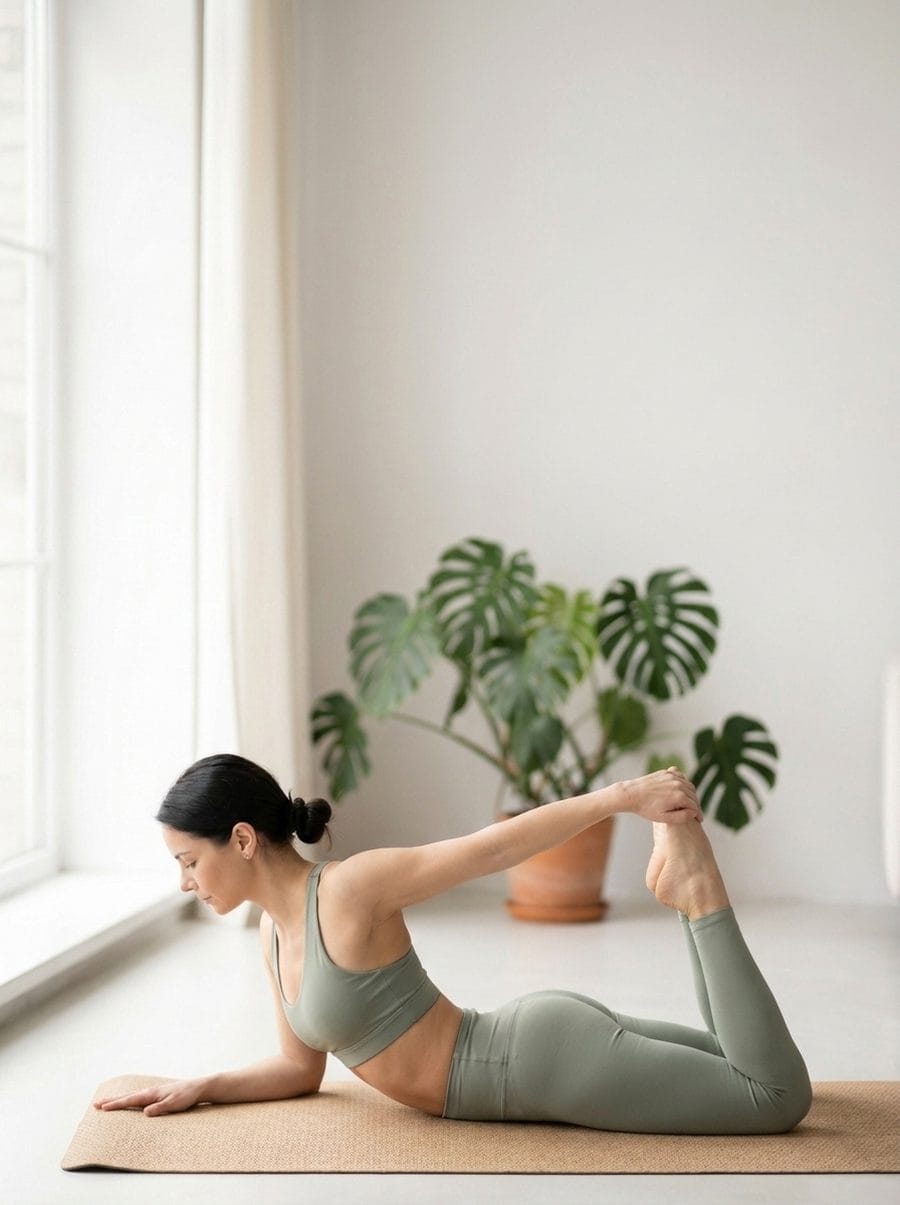
One-Legged King Pigeon Pose, or Eka Pada Rajakapotasana, joins a hip opener with a backbend: from Pigeon Prep you bend your back leg, catch the foot and lift your chest. For many practitioners it's a goal pose. The level is advanced.
The app includes it in the Deep Backbend sequence with a 35-second hold per side; the pose card suggests 30 seconds.
How to do it
- EnterFrom Pigeon Pose prep, bend your back leg and catch the foot with your hand or in the crook of your elbow. Your chest turns forward and up.
- HoldKeep your hips level and let the backbend grow from your upper back. Your foot reaches toward the back of your head, but without forcing. Your breath matters more than depth.
- ExitCarefully release your foot, extend your back leg, and lower onto your forearms.
More detail
The app advises learning King Pigeon after Pigeon Pose (Prep), so your hips should already settle comfortably in the basic version. From the prep, walk your torso up onto straight arms, bend your back leg and reach for the foot with the hand on the same side.
If your fingers don't reach, loop a strap around the foot and hold it. Hooking the foot in the crook of your elbow is easier than an overhead grip, so start there. Your breastbone moves forward and up, the lower back stays long, and your head follows the chest without dropping back.
Come out just as slowly: release the foot, straighten the leg and rest in Child's Pose.
Benefits
Combines a hip opener with a backbend — a goal pose for many practitioners.
The pose stretches the quadriceps of your rear leg and the glute of the front leg and opens your chest and shoulders. Backbending with level hips teaches you to spread the arch along the whole spine instead of folding at the lower back.
For this reason it sits near the end of the sequence, once your body is warm.
Cautions
- Knee and lower back injuries
- Learn it after Pigeon Pose (Prep)
This site is for general information and is not medical advice. If you have pain, an injury, a chronic condition, or are pregnant, check with a qualified professional before practicing.
Common mistakes
- Skipping Pigeon Prep. Without it, your knee and lower back take on too much.
- Letting the hips tip toward the front leg. Slide a block under that glute.
- Folding at the lower back. The bend starts in the upper back.
- Yanking the foot toward your head. Depth comes with calm breathing, not with arm strength.
Counterpose

Where it appears
- Deep Backbend 35 min · Advanced
Similar poses

Questions
What does Eka Pada Rajakapotasana mean? "Eka" means one, "pada" foot or leg, "raja" king and "kapota" pigeon. So it's the one-legged king pigeon pose, named for the back leg whose foot you hold.
What are the preparatory poses for Eka Pada Rajakapotasana? The main one is Pigeon Prep. In Deep Backbend, it's also preceded by Low Lunge and Bird Dog with Foot Hold, which prepare your front thighs and shoulders for the grip.
Who should avoid King Pigeon? The app lists knee and lower back injuries: if you have either, skip the pose. And don't start with it until Pigeon Prep feels familiar.
Updated: