 Hatha Yoga
Diaphragmatic Breathing: How to Learn Belly Breathing
Hatha Yoga editorial team · Updated · 8 min read
Diaphragmatic breathing is often called belly breathing: as you inhale, your belly gently rounds while your shoulders and upper chest stay almost still. It's a simple skill, yet at a desk or in a rush it slips away, and the breath turns short and high in the chest.
This guide covers the technique lying down and seated, a quick hand test, poses from the Hatha Yoga app where this breathing happens on its own, and what studies say about its benefits.
What diaphragmatic breathing is
The diaphragm is a broad, dome-shaped muscle between your chest and your abdomen, and it's the main muscle you use to inhale. When it contracts, the dome flattens and moves down, your lungs expand downward, and your abdominal organs shift forward.
That's why your belly rises on the inhale, even though the air of course goes into your lungs. On the exhale, the diaphragm relaxes and moves back up.
In chest breathing, the muscles between the ribs, in the neck and in the shoulders do most of the work. Each breath is short, and the shoulders creep toward the ears. In diaphragmatic breathing, the belly and lower ribs move first, and the chest joins in gently at the very end.
In hatha yoga, belly breathing is learned as the first stage of Full Yogic Breath, where each inhale fills the belly first, the ribs next and the upper chest last. The app calls that technique the foundation for every other pranayama.
The hand test: how do you breathe right now?
Sit or lie down, rest one hand on your belly just below the navel and the other on your chest. Breathe normally for a minute and watch.
- Mostly the top hand rises: you're a chest breather.
- Both hands move about the same: your breathing is mixed.
- The bottom hand rises while the top one barely moves: that's diaphragmatic breathing.
The app uses the same hand placement in Full Yogic Breath and in Reclining Butterfly Pose, so you can repeat this check right on your mat.
How to do diaphragmatic breathing: start lying down
Lying down is the easiest way to learn, because your back doesn't have to hold you upright and your belly softens by itself.
- Lie face up with knees bent and soles flat on the floor, hip-width apart. A folded blanket under your head is fine.
- Place your hands on your belly and chest, as in the test.
- Breathe in through your nose calmly, not to the max, and let the bottom hand lift.
- Breathe out slowly. Your belly falls on its own; you don't have to pull it in.
- Keep going for 5 minutes. If you like counting, borrow the rhythm of Full Yogic Breath from the app: inhale for 4, exhale for 6.
Britain's NHS offers a very similar routine for stress: breathe into your belly without forcing, count to five on the way in and on the way out, and continue for at least five minutes. The NHS suggests exhaling through the mouth, while in yoga you usually breathe through the nose in both directions.
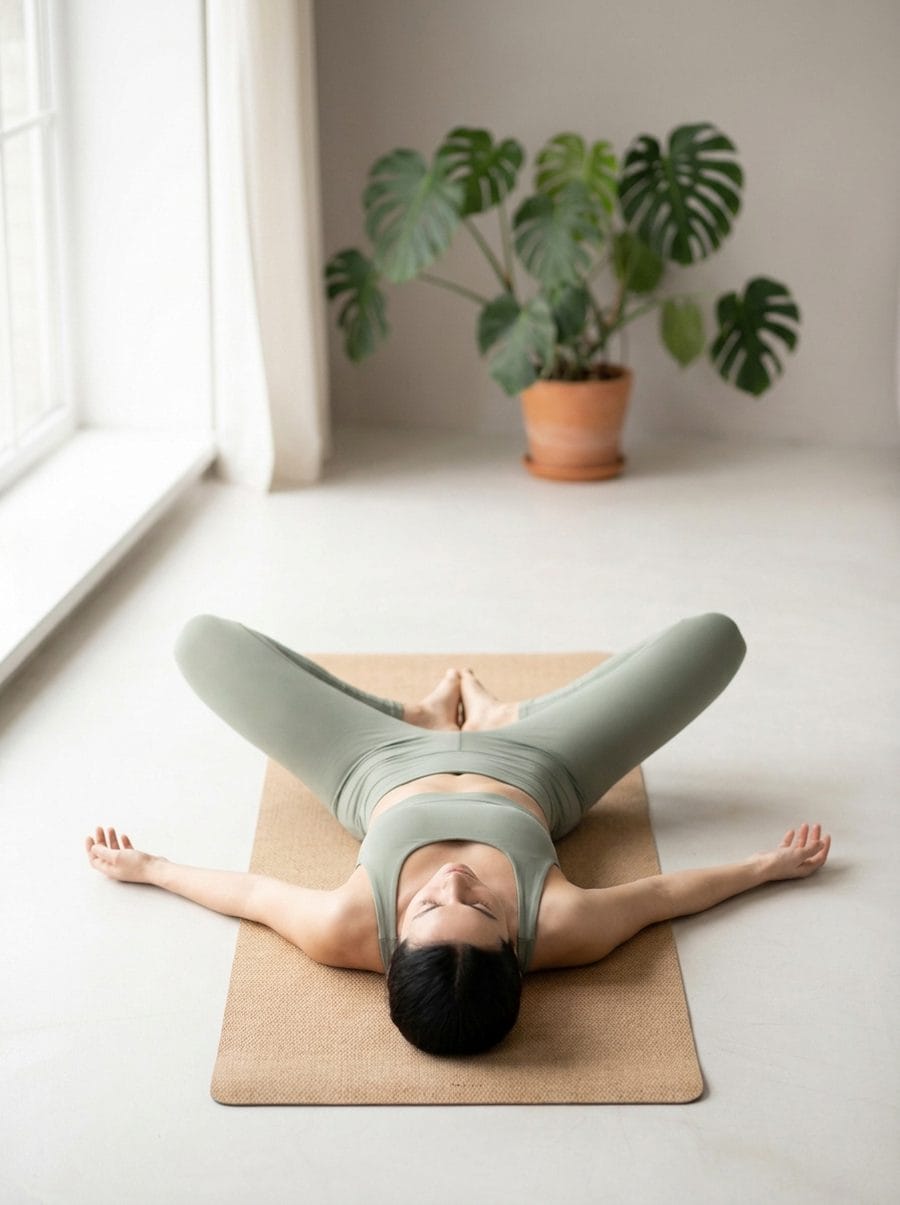
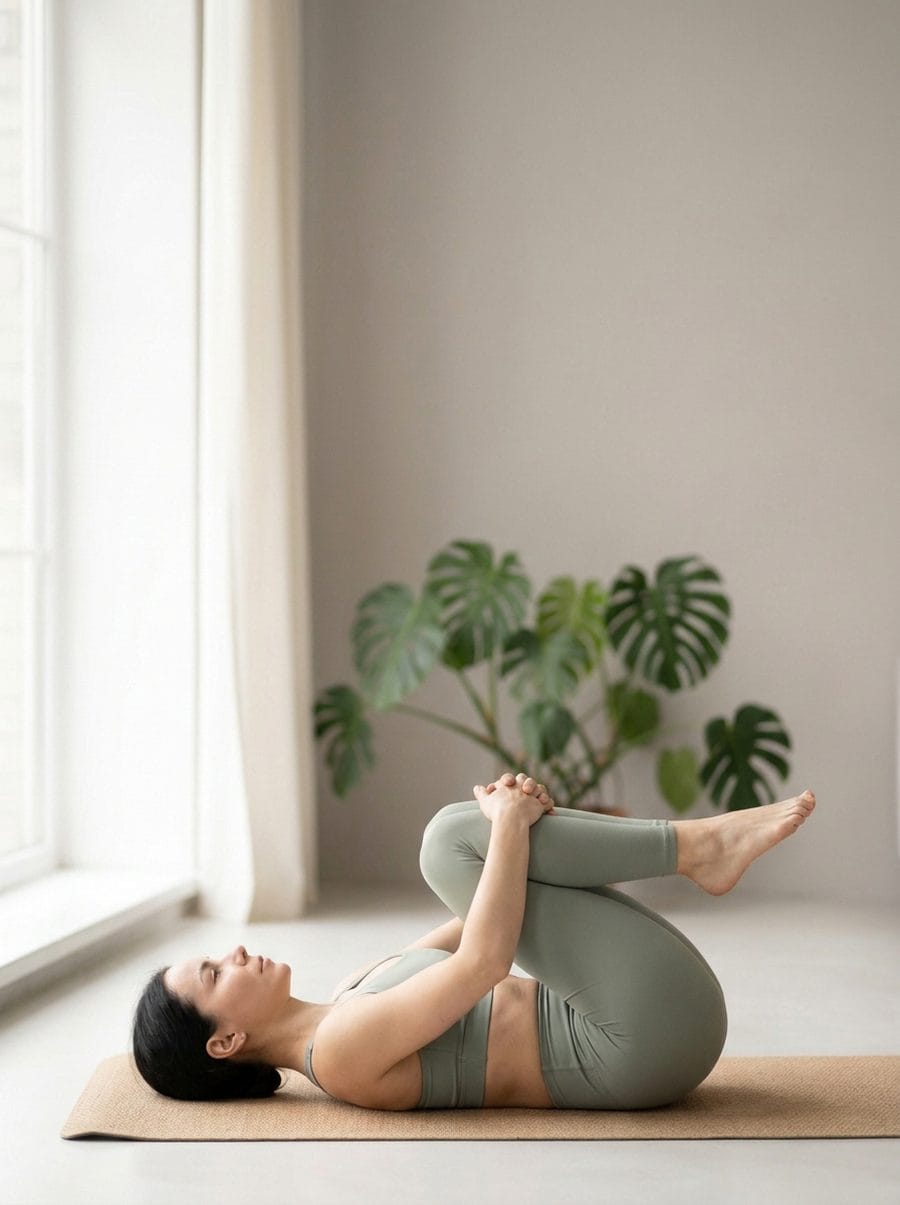

These four poses from the app let you feel your belly working with almost no effort. In Reclining Butterfly Pose, the app asks you to simply watch your belly rise as you breathe in and fall as you breathe out.
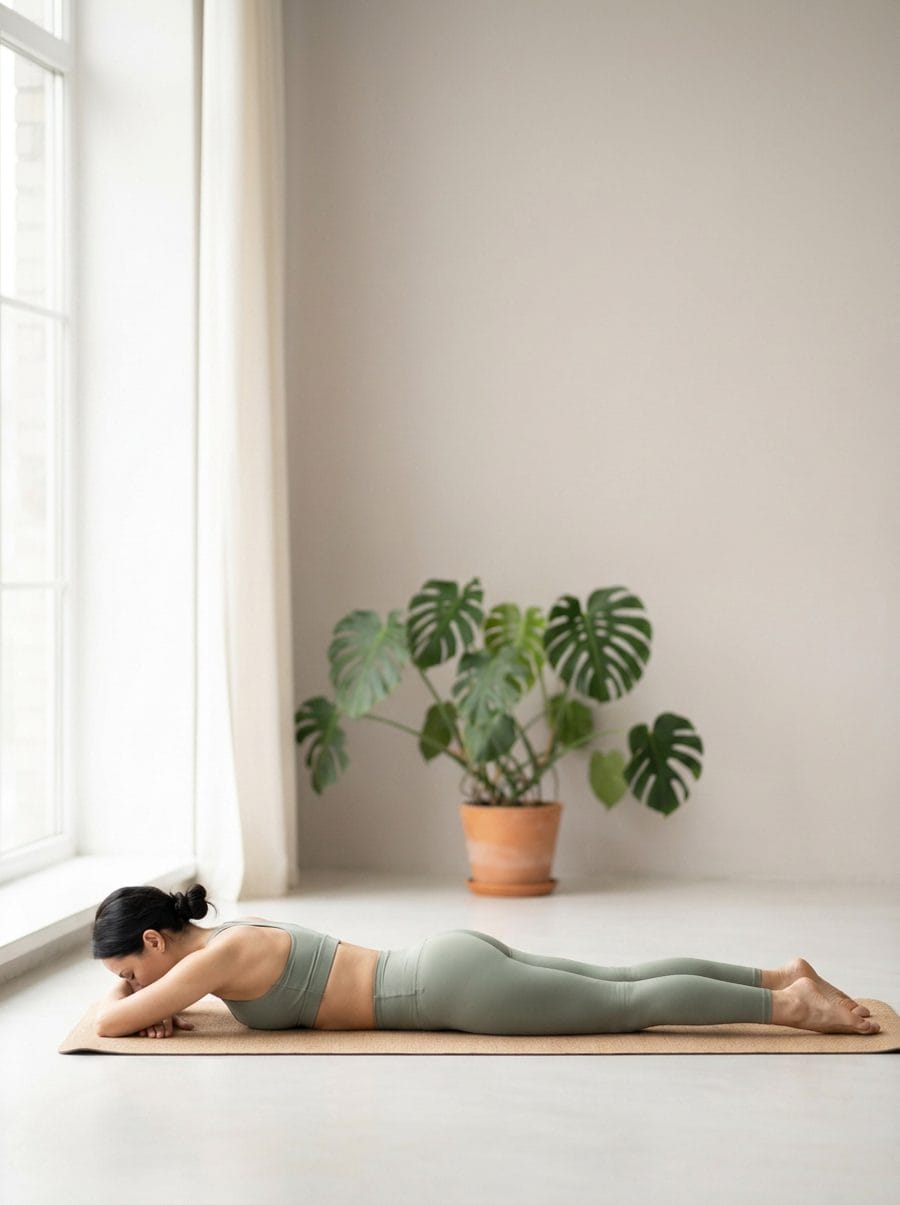
In Knees-to-Chest Pose, breathe calmly into your belly: hug your knees in a little as you exhale and ease them away as you inhale. In Crocodile Pose, you lie face down with your forehead on your stacked forearms, and every inhale feels like a soft rocking of the lower back.
In Relaxation Pose, you let go of control altogether and just notice where the air travels.
Seated: carry the skill into pranayama
Once it works lying down, sit up. Keep your spine tall, your shoulders low and your belly free; a tight waistband or belt gets in its way. Easy Pose with crossed legs works well, and when your knees end up above your hips, tuck a rolled blanket under your sitting bones.
The other option is Thunderbolt Pose, where you kneel and sit back on your heels. According to the app, you can practice it right after a meal, but skip it with injured knees or ankles.
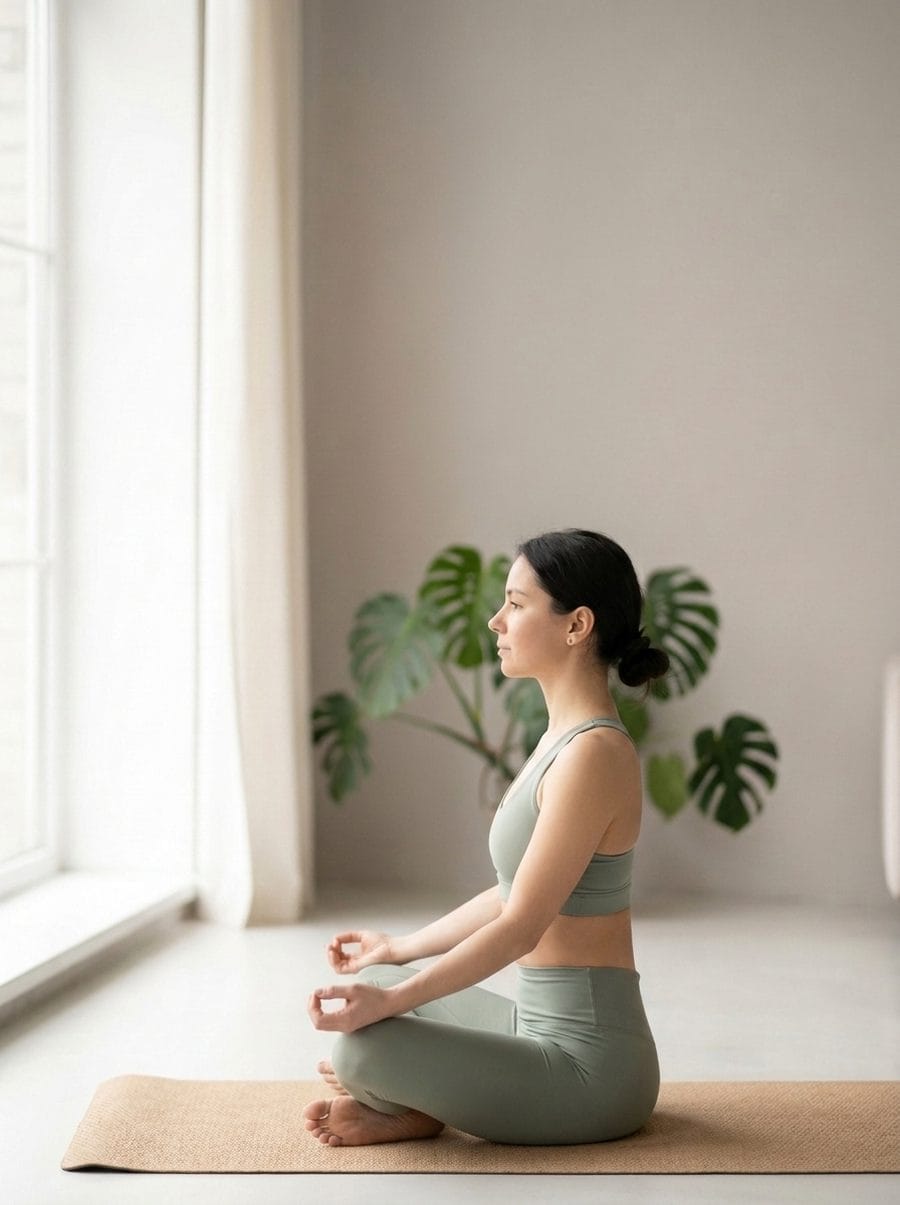
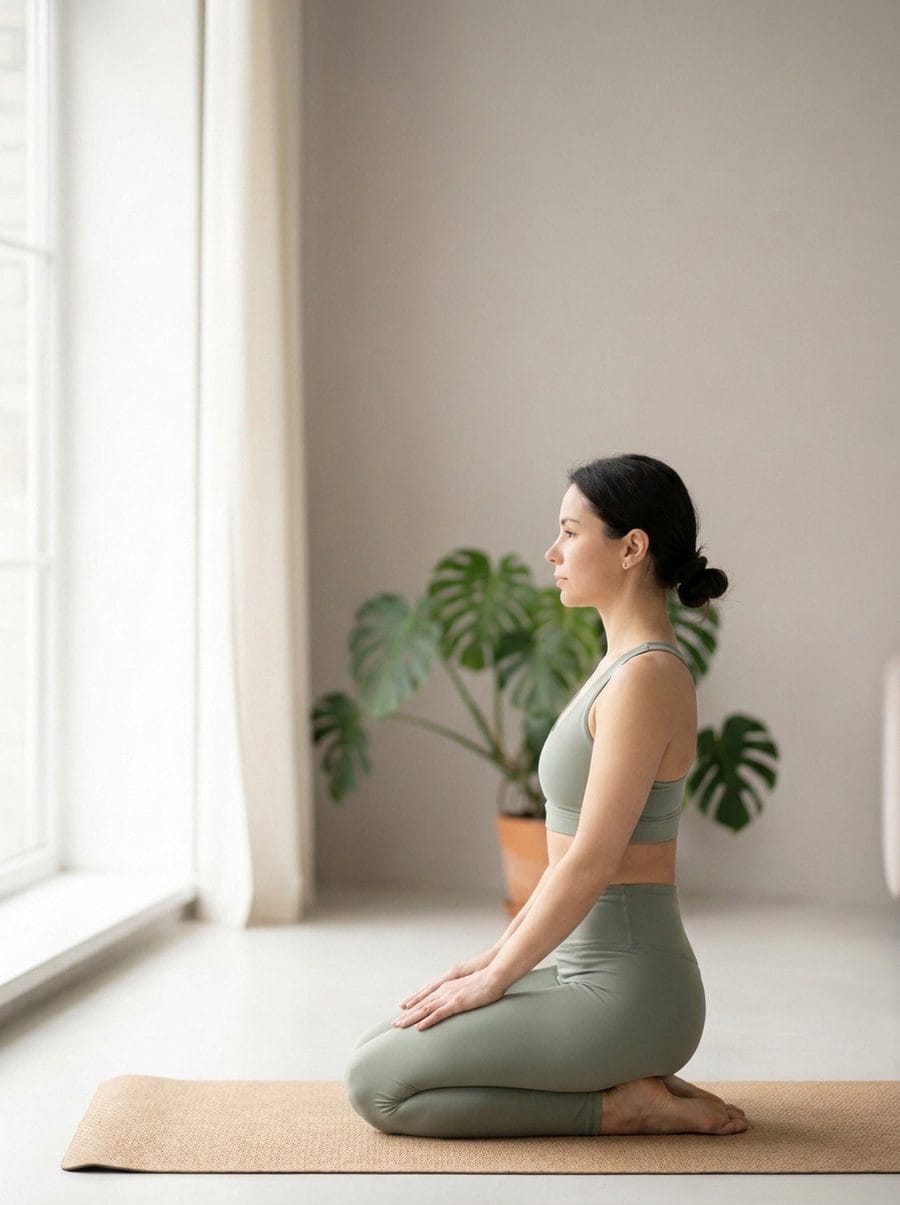
From here, belly breathing becomes the base for pranayama. In Full Yogic Breath, the lower ribs and then the chest join the belly. In Coherent Breathing, the belly moves in an even 5 and 5 rhythm, which is six breaths a minute.
For breathing inside the poses themselves, read Breath in Practice, and you'll find all eight of the app's techniques in our guide to breathing exercises for beginners.
Diaphragmatic breathing benefits: what the research says
Belly breathing is studied as a simple way to relax. So far there isn't much research, and the studies are small.
- A 2019 review (Hopper et al.). Only three studies met its strict criteria: one randomized trial and two without full randomization. All three found lower stress markers after practice: salivary cortisol and breathing rate in one, blood pressure in another, a stress questionnaire score in the third. The authors are careful: this kind of breathing may reduce stress, and more research is needed.
- A 2017 study (Ma et al.). Forty healthy adults were split into two groups. One group did 20 sessions over 8 weeks with a feedback device, breathing about 4 times a minute on average. Compared with the control group, they reported less negative mood, had lower cortisol and held their attention better.
- NCCIH. This US federal agency for complementary health approaches lists slow, deep diaphragmatic breathing among relaxation techniques. Their aim is the relaxation response: slower breathing, lower heart rate and lower blood pressure. For healthy people, these techniques are generally considered safe, though now and then someone feels more anxious.
The bottom line: diaphragmatic breathing helps many people settle down, and all it takes is five minutes. Still, it's no substitute for a doctor's care if you live with an anxiety disorder or blood pressure problems.
How long and when to practice
To start, 5 minutes once or twice a day is plenty; that's the default length of Full Yogic Breath in the app. Consistency beats duration. Good times are in the morning before breakfast or in the evening before bed. After a heavy meal it's better to wait, and if you want to breathe right away, sit in Thunderbolt Pose and keep the breath soft, without big inhales.
For evenings when your tank is low, the app has the Low-Energy Day program: 14 minutes entirely on the floor, beginner level, 12 poses. It includes Crocodile Pose, Knees-to-Chest Pose and nearly four minutes of final relaxation, exactly the positions where the belly breathes most easily.
Common mistakes
- Pushing the belly out. Your belly rises because the diaphragm moves down, not because you shove it forward. The motion stays soft.
- Filling up to the max. Overly deep breaths can make you dizzy. Keep the usual amount of air and just change where it goes.
- Holding your breath. There are no pauses here: the inhale flows straight into the exhale.
- Confusing it with a stomach vacuum. Sucking the abdomen in and up once the lungs are empty is closer to Uddiyana Bandha. That's a separate practice for before meals, and it's skipped during pregnancy, with high blood pressure and with flare-ups of abdominal conditions. Learn more in Bandhas: Energy Locks.
Safety
Calm belly breathing suits nearly everyone. The cautions in the app concern the poses:
- Skip Crocodile Pose once you reach your second trimester, since you lie on your belly.
- In those months, do Knees-to-Chest Pose with the knees spread wider than the bump, or leave it out too.
- Thunderbolt Pose loads the knees and ankles, so drop it after an injury there.
If you feel dizzy or uneasy, drop the count, return to your usual rhythm and sit quietly for a while. After abdominal surgery, after giving birth, or if you have reflux or a lung condition, talk to your doctor before starting breathing exercises. For more on limits, see Safety and Contraindications.
Pose cautions in this article
- Pregnancy from the second trimester onward — the pose is done lying on the belly (Crocodile Pose)
- Groin discomfort — place supports under your knees (Reclining Butterfly Pose)
- Pregnancy from the second trimester onward — take your knees wider than your belly or skip the pose (Knees-to-Chest Pose)
- Knee discomfort — sit on a prop (Easy Pose)
- Knee and ankle injuries (Thunderbolt Pose)
This site is for general information and is not medical advice. If you have pain, an injury, a chronic condition, or are pregnant, check with a qualified professional before practicing.
Questions
Belly breathing vs. chest breathing: what's the difference? In chest breathing, the muscles between the ribs, in the neck and in the shoulders do most of the work, so each breath is short. In diaphragmatic breathing, the diaphragm leads: the belly moves and the shoulders stay quiet.
Can you do diaphragmatic breathing after eating? Gently and without big inhales, yes, ideally in Thunderbolt Pose. Save a full session for before a meal or for when your food has settled.
How long should you do diaphragmatic breathing each day? Start with 5 minutes, the standard length of Full Yogic Breath in the app. You can repeat it in the morning and in the evening.
Is belly breathing bad for you? For most people it isn't. Problems come from forcing it: pushing the belly out or taking huge breaths can leave you lightheaded. Keep it soft, and if you have a lung condition or recent abdominal surgery, get your doctor's okay first.
Sources
- Hopper SI, et al. Effectiveness of diaphragmatic breathing for reducing physiological and psychological stress in adults: a quantitative systematic review. JBI Database of Systematic Reviews and Implementation Reports, 2019.
- Ma X, et al. The Effect of Diaphragmatic Breathing on Attention, Negative Affect and Stress in Healthy Adults. Frontiers in Psychology, 2017.
- National Center for Complementary and Integrative Health. Relaxation Techniques: What You Need To Know.
- NHS. Breathing exercises for stress.
- Pranayama rhythm and technique, poses and their cautions, program contents: the Hatha Yoga app. How we verify our texts is explained on the How We Prepare Our Content page.
Read next
- Yoga for Arthritis and Osteoporosis: How to Protect Your Joints and Bones7 min read
- Ashtanga Yoga Explained: The Series, the Breath and the Difference from Hatha6 min read
- Ayurveda Explained Simply: The Basics and a Daily Routine (Dinacharya)5 min read
- Balance Exercises: 10 Yoga Poses for Balance and Stability7 min read