 Hatha Yoga
Four-Limbed Staff Pose
Caturaṅga Daṇḍāsana
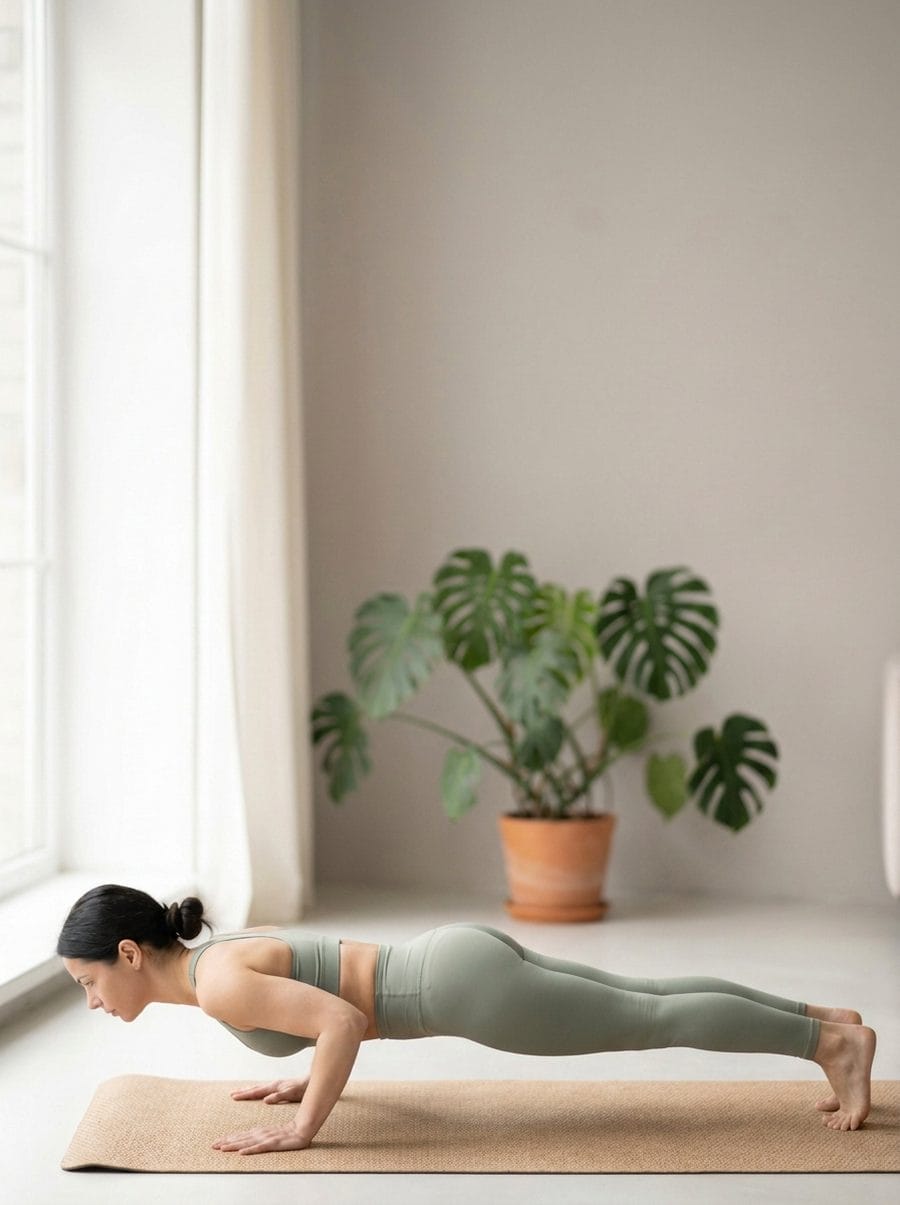
Four-Limbed Staff Pose, or Chaturanga Dandasana, is a low push-up hold on your palms and toes with bent elbows: your body hovers just above the floor in one straight line. "Chatur" means four, "anga" limb and "danda" staff. Intermediate in the app, it's set at 15 seconds.
Two advanced sequences hold it longer: Arm Balances: Path to Crow for 35 seconds and Advanced Intensive for 30.
How to do it
- EnterFrom Plank Pose, exhale and bend your elbows straight back along your sides. Lower until your elbows form a right angle, keeping your body in one line.
- HoldKeep your elbows hugging your ribs and your shoulders no lower than your elbows. Your body is firm as a board, belly and legs engaged. To make it easier, lower your knees.
- ExitLower onto your belly, or press back up into Plank Pose.
More detail
Chaturanga grows out of a confident Plank Pose; if half a minute of Plank is still a struggle, it's too early. For beginners the app suggests a knees-down version, and that's the main prep drill. Lower slowly and only as far as your shoulders can stay level with your elbows or higher; at first, halfway is plenty.
Before lowering, shift your body a touch forward so your elbows end up stacked over your wrists at the bottom. Steer your elbows back along your ribs, not out to the sides. If you can't hold the low position yet, lower all the way onto your belly and press back up with your body still straight.
After strength work like this, the app offers a rest in Child's Pose.
Benefits
The key strength pose of vinyasa: triceps, chest, and a rock-solid core.
The pose strengthens your triceps, chest, the front of your shoulders and the trunk muscles that keep your body from sagging. In vinyasa, every transition from Plank into a backbend passes through it, so its quality decides how many rounds your shoulders can handle.
A solid Chaturanga also smooths the path toward arm balances like Crow Pose.
Cautions
- Wrist and shoulder injuries
- Beginners — keep your knees on the floor
This site is for general information and is not medical advice. If you have pain, an injury, a chronic condition, or are pregnant, check with a qualified professional before practicing.
Common mistakes
- Shoulders dipping below elbow height. Stop higher.
- Elbows flaring wide. Keep them hugging your sides.
- Hips sagging or piking up. Belly and legs hold the line.
- Head dropping and gaze aimed under you. Neck long, eyes on the mat a little forward.
Counterpose

Where it appears
- Arm Balances: Path to Crow 20 min · Advanced
- Advanced Intensive 35 min · Advanced
Similar poses
Questions
How do I build up to Chaturanga as a beginner? Strengthen your Plank, then lower from your knees as the app recommends for beginners. Next, lower slowly from straight legs to the halfway point, and later add a hold of a few seconds.
Who should avoid Chaturanga? Skip it with damaged wrists or shoulders: the app excludes it then.
What does Chaturanga Dandasana mean? From Sanskrit: "chatur" is four, "anga" a limb or body part, "danda" a staff. The four supports are your two hands and two feet, and your straight body is the staff.
Updated: