 Hatha Yoga
Supine Twist with Eagle Legs
Supta Parivṛtta Garuḍāsana
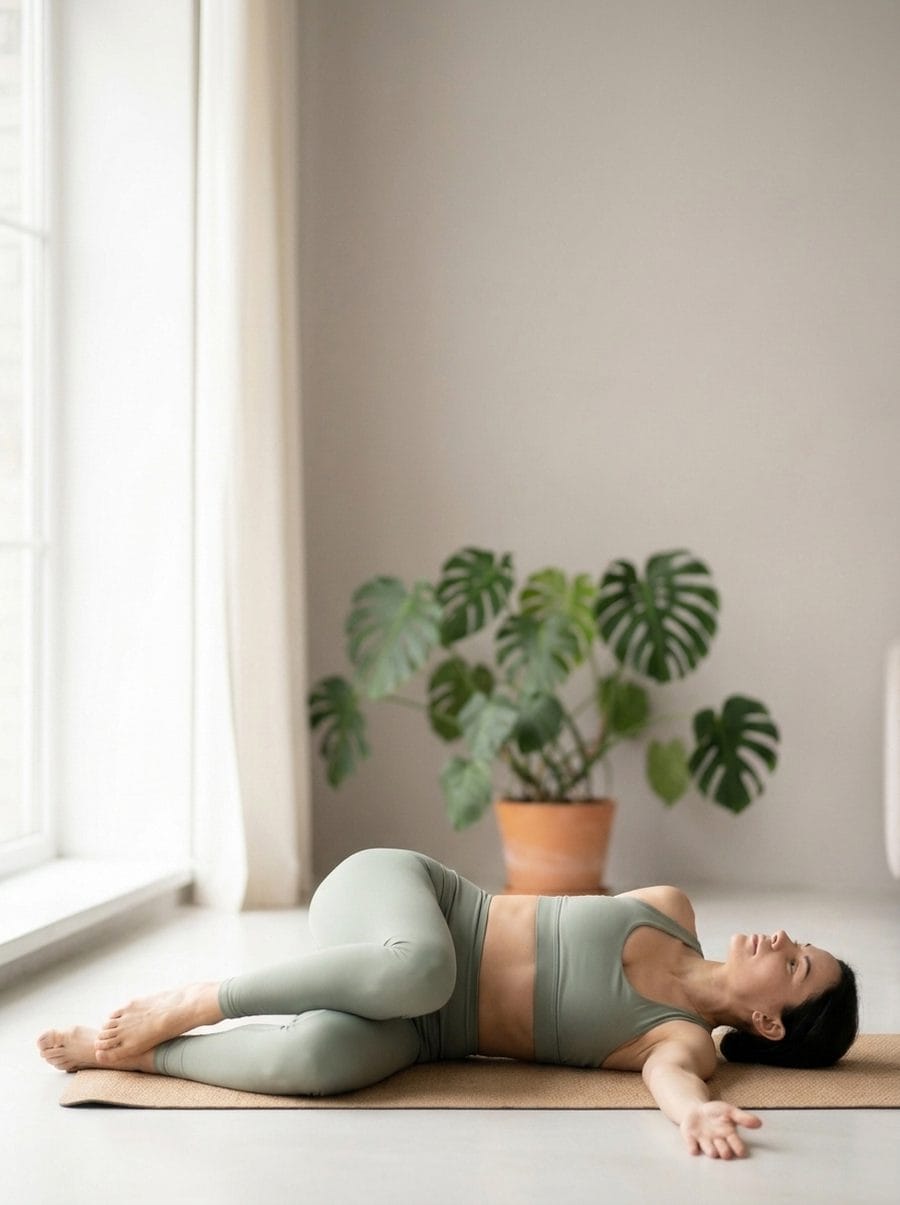
Supine Twist with Eagle Legs, or Supta Parivrtta Garudasana, is a passive twist on your back: legs wrapped as in Eagle Pose, both knees tipping over to one side, shoulders anchored. Beginners can do it; each side takes 45 seconds in hatha and two minutes in yin.
In the app it closes out Lower Back After Sitting, following Child's Pose right before final relaxation. Two yin sequences use it as well.
A variation of: Eagle Pose
How to do it
- EnterLying on your back, wrap your legs as in Eagle Pose, one thigh over the other. Lower your knees toward the side of your bottom leg and open your arms out to the sides.
- HoldKeep both shoulders on the floor and gaze away from your knees. Let gravity do the work.
- ExitBring your knees back to center, unwrap your legs, and switch sides.
More detail
Start on your back, soles planted, knees pointing up. Cross your right thigh over your left, as high toward the groin as you can; if it's available, hook your right foot behind your left calf, though that part is optional.
Shift your hips a couple of inches to the right, and only then lower your wrapped knees to the left, toward the bottom leg. Open your arms into a T and look toward your right hand. If your right shoulder lifts off the mat, slide a pillow or block under your knees: the twist gets smaller, but your back can let go.
Long exhales help your spine release, and gravity does the work instead of your muscles.
Benefits
A deep passive twist that targets the outer thigh.
It's a deep yet passive twist: your spine rotates under the weight of your legs, while the crossed thighs add a stretch along the outer line of the top leg's thigh. Long exhales help ease tension that builds up in your back from a day in a chair.
That's why the lower back sequence saves it for the very end, when your muscles are warm and ready to relax.
Cautions
- Lumbar disc herniation — go more gently
This site is for general information and is not medical advice. If you have pain, an injury, a chronic condition, or are pregnant, check with a qualified professional before practicing.
Common mistakes
- Lifting the opposite shoulder to get your knees lower. The shoulder matters more: prop your knees instead.
- Pushing your knees down with your hand. The twist is passive; let the weight of your legs work.
- Crossing your legs down near the knees. Stack thigh on thigh, closer to the groin.
- Holding your breath. Lengthen your exhales; that's when the back releases.
Where it appears
- Lower Back After Sitting 15 min · Beginner
- Yin: Twists 30 min · Beginner
- Yin: Let the Day Go 30 min · Beginner
Similar poses
Questions
What does Supta Parivrtta Garudasana mean? "Supta" means reclining, "parivrtta" revolved, and "garuda" eagle, or more precisely Garuda, the mythical bird. Literally, it's a revolved Eagle Pose lying down.
Is it okay with a lumbar disc herniation? Yes, but softer, per the app's note for this case: stop the knees short of the floor, rest them on a pillow and turn less. With a herniated disc, check with a doctor before you practice.
Featured in
Updated: