 Hatha Yoga
Sphinx Pose
Ardha Bhujaṅgāsana
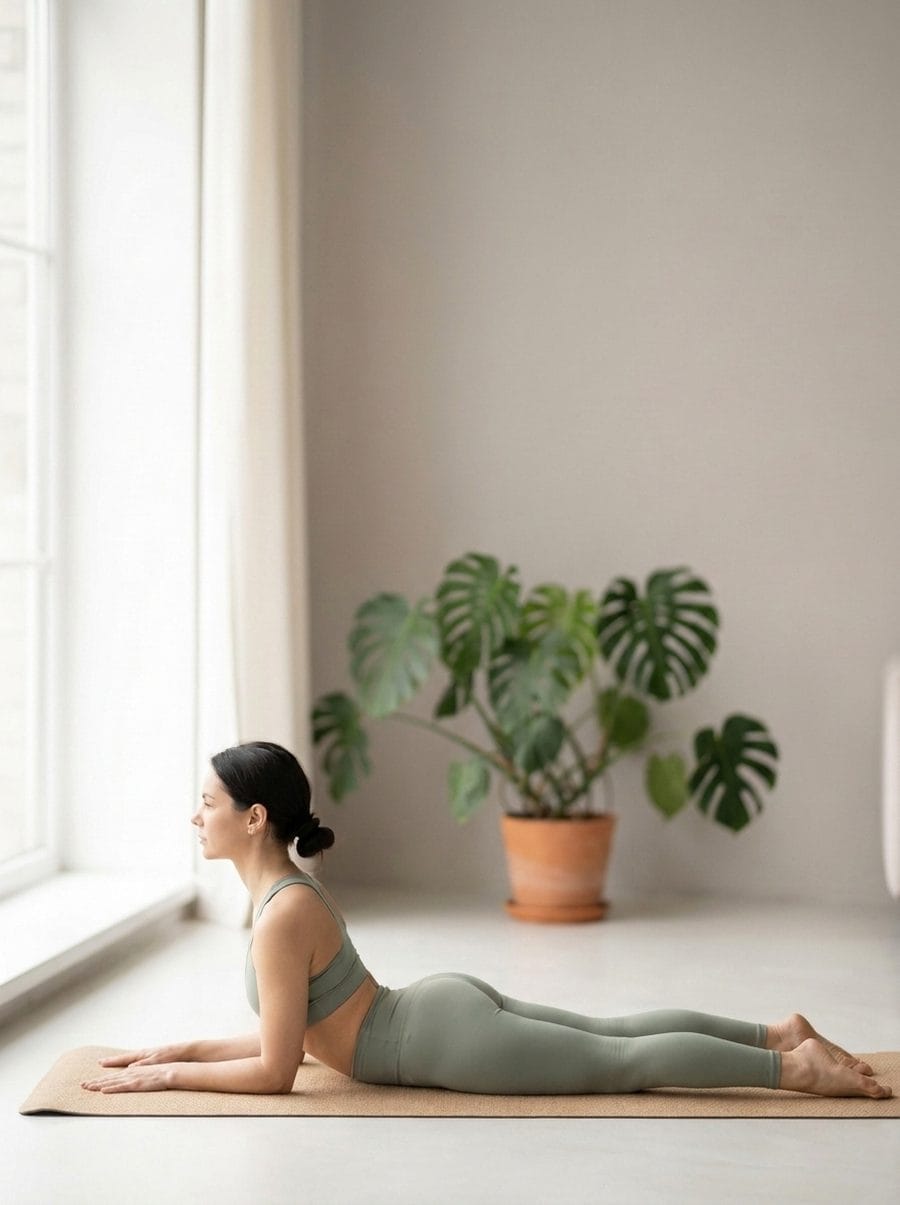
Sphinx Pose, or Ardha Bhujangasana, is the gentlest belly-down backbend: the chest lifts while your forearms, not your hands, carry you. It's beginner level. Sphinx opens the Backbends & Opening sequence, starts the belly backbend block in Deep Backbend and shows up in the Evening Spiral flow.
The pose card gives it 45 seconds; in hatha sequences it lasts 45 to 75, and ten yin sequences stay in it for two to five minutes.
A variation of: Cobra Pose
How to do it
- EnterLying on your belly, place your forearms on the floor with your elbows under your shoulders. Gently lift your chest.
- HoldPress your pubic bone into the floor and draw your shoulders away from your ears. A soft backbend with no strain, open to everyone.
- ExitLower your chest and relax on your belly.
More detail
Lie with your legs hip-width apart, insteps down. Your forearms run parallel, palms down and fingers forward. Elbows under your shoulders give you the full Sphinx; if your lower back feels crowded, walk them slightly forward and the curve becomes flatter.
Before you rise, draw your low belly in a little and feel your pubic bone press into the floor. That spreads the arch along your whole spine instead of piling it up just above the sacrum. Draw your chest forward as if it were sliding out between your shoulders, and let your shoulder blades glide down.
The back of your neck stays long, gaze forward and a touch down. Don't chase height: Sphinx earns its place because you can breathe calmly in it for a long time.
Benefits
The safest backbend — for a healthy lower back and good posture.
The pose broadens your chest, stretches the front of each shoulder and engages your back muscles with hardly any load on your arms. Its broad base lets you stay longer than in Cobra and notice your rib cage widen as you inhale.
In both hatha sequences Sphinx comes right before Cobra as a stepping stone, and Child's Pose balances the backbend.
Cautions
- Acute lower back pain
This site is for general information and is not medical advice. If you have pain, an injury, a chronic condition, or are pregnant, check with a qualified professional before practicing.
Common mistakes
- Shoulders hunched by your ears. Press your forearms down and draw your shoulders back.
- Elbows sliding wider than your shoulders. Bring them back in line with the joints.
- All the bend dumping into your lower back. Firm your belly and reach your chest forward rather than up.
- Chin jutting up. Let your neck extend the curve of your spine instead.
Counterpose

Where it appears
- Backbends & Opening 20 min · Intermediate
- Yin Practice 35 min · Beginner
- Deep Backbend 35 min · Advanced
- Yin: Spine 40 min · Intermediate
- Deep Yin 60 min · Advanced
- Morning Yin 15 min · Beginner
- Yin After Sitting 15 min · Beginner
- Yin: Lower Back 20 min · Beginner
- Yin: Twists 30 min · Beginner
- First Yin 30 min · Beginner
- Full-Body Yin 50 min · Intermediate
- Deep Yin: Spine 60 min · Advanced
- Warm-up: Evening Spiral A calm round to end the day: folds and gentle twists on the floor, no standing up, finishing seated
Similar poses
Questions
Sphinx vs Cobra: what's the difference? In Sphinx you rest on your forearms, so the backbend stays shallow and calm. Cobra puts you on your palms, lifts your chest higher and asks more of your back muscles. That's why most people learn Sphinx first.
Can I do Sphinx if my lower back hurts? Not during acute lower back pain, which rules the pose out; skip it until that passes. If the pain is chronic or followed an injury, talk your practice over with a doctor.
What does Ardha Bhujangasana mean? "Ardha" means half and "bhujanga" means serpent, so it's a sort of half-strength Cobra. Some schools call the same shape Salamba Bhujangasana, or supported Cobra.
Featured in
- How to Do a Backbend: Yoga Backbends for Beginners, from Sphinx to Wheel6 min read
- Yin Yoga for Beginners: Your First Routine at Home6 min read
- Yin Yoga for Hips and Lower Back: Poses, Holds and Cautions7 min read
- Yin Yoga Poses: 15 Key Poses With Props and Cautions7 min read
- What Is Yin Yoga? Long Holds Without Effort, Explained7 min read
- Posture Exercises: 10 Yoga Poses to Stand Taller and Stop Slouching7 min read
Updated: